
Foreword from the Founder
-
A museum should not exist only to preserve what has already happened.
The Major André Collection™ looks to the past in order to place its knowledge, skills, and ways of thinking back into circulation.
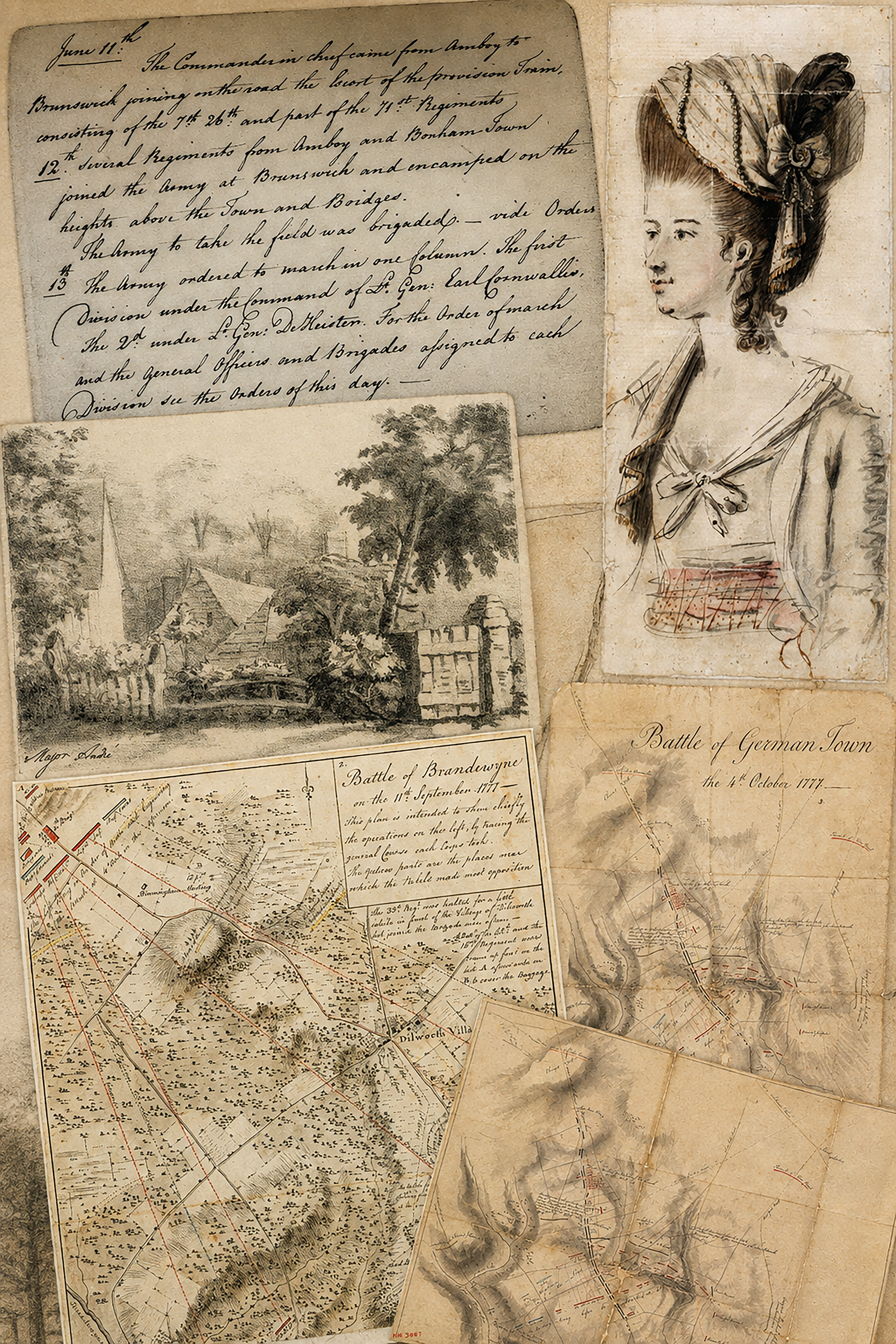
Historical objects are therefore treated not simply as things to be protected behind glass, but as points of connection between generations. A letter can teach writing and correspondence. A map can introduce navigation, geography, and the history of spatial thought. A scientific instrument can lead into observation, measurement, mathematics, and experimentation. A drawing can become an encounter with proportion, technique, and visual communication. A manuscript can teach us not only what someone wrote, but how thought once moved from mind to hand.
The educational work of the Collection begins in that meeting place.
Its programmes will pair historical materials with practical contemporary learning, allowing young people to encounter earlier disciplines not as obsolete customs, but as living skills capable of being examined, adapted, and used again.
The purpose is not to recreate the eighteenth century.
It is to ask what the twenty-first century might recover from it.
That distinction matters. History becomes most useful when it does more than explain how people once lived. It can also reveal capacities we have neglected, methods we have forgotten, and forms of attention worth carrying forward.
The forthcoming John André Penmanship Programme is the first expression of this approach. Through historical handwriting, manuscripts, correspondence, and writing materials, students will study the mechanics and culture of the written hand while developing a legible and confident hand of their own.
Future educational initiatives will extend this principle across other areas represented within the Collection: observation, language, cartography, measurement, scientific instruments, material culture, music, art, correspondence, and the transmission of knowledge itself.
In this sense, the Collection is concerned with more than preserving inheritance.
It is concerned with continuity.
The past supplies the record.
The present examines it.
The future decides what becomes possible from what we have learned. -
It is often said that history is written by the victors. Less often considered is what happens when the person being written about can no longer answer.
We recognize an obligation not to desecrate the resting places of the dead. We preserve graves, protect remains, return disturbed bodies to the earth, and understand that death does not extinguish the dignity owed to a human being.
Yet no comparable boundary reliably protects memory.
Once a person dies, a life may be dismantled and rearranged by strangers: reduced to a face, a romance, a political usefulness, a manner of death, or the single day for which later generations find that person easiest to remember.
Major John André has endured this peculiar form of afterlife for more than two centuries.
His youth and appearance made him particularly susceptible to romanticization. His execution supplied the tragedy. His surviving letters and artistic accomplishments supplied the sensitivity. Later generations repeatedly assembled these fragments into the beautiful, doomed figure they wished him to be. Sentimental literature, engravings, legend, disputed attribution, and eventually popular history reinforced the image until the circumstances of his death became more familiar than the substance of his life.
In the modern era, that reduction has taken new forms. André has at times been reduced to little more than his appearance, recast as a historical heartthrob, while elsewhere his image has been stripped of context and repurposed as a villainous mask in children’s entertainment. These are very different treatments, but they produce the same result: the person disappears behind a simplified image.
Romantic hero, handsome curiosity, villain, spy, martyr—each can become another way of avoiding the harder task of remembering the whole human being.
There is nothing wrong with mourning a historical figure, nor with recognizing beauty, tragedy, or tenderness where the evidence permits it.
But remembrance carries an obligation of its own.
Admiration should not become another form of erasure.
-
Before André was the prisoner at Tappan, before Arnold and West Point, before the gallows and the centuries of interpretation that followed, there was a living man moving through his own present tense: studying, travelling, drawing, singing, writing, learning languages, forming friendships, pursuing advancement, creating beauty, performing duties, and imagining a future he had every reason to believe he would live to see.
That is the life this Collection seeks to place back into view.
My connection to this history developed over the course of my life, though not in a straightforward way.
After a particular series of events brought this history back into my focus, I returned to the record with a different level of attention—and with a clearer sense of the task before me: to restore the life before the gallows became the introduction. The Collection exists so that future generations encounter André first through the breadth of his mind, work, relationships, and world—not through the spectacle of his death.
The historical record preserves an artist as well as a soldier; a linguist and European student as well as an English officer; a poet and singer beside the administrator; a draftsman and mapmaker beside the intelligence chief. Theatrical imagination existed beside military discipline, while humour, curiosity, friendship, and tenderness remained present within the machinery of war.
And everywhere, eventually, the gallows.
The ending had colonized everything that came before it.
The Major André Collection™ grew from a desire to reverse that direction of travel.
Its purpose is not to manufacture a different André, nor to acquit, condemn, romanticize, or possess him. Historical affection is no substitute for historical discipline. If anything, caring deeply about a subject creates a greater obligation to distinguish what we know from what we wish to know, evidence from inheritance, and the person from the mythology accumulated around him.
The responsibility of this Collection is therefore simple, even when the work is not:
Return to the record.
Gather the letters. Read the books. Follow the citations backward rather than relying upon copies of copies generated from incomplete records online. Recover the objects. Examine the handwriting. Reconstruct the places. Identify the instruments and technologies. Study the languages, faiths, intellectual traditions, military structures, artistic practices, and human relationships that constituted the world in which this life was actually lived.
And when something has been repeated for two centuries, ask again whether it is true.
The Collection consequently extends beyond André himself. No human being exists without context. To recover one life requires recovering something of the world capable of producing it: the books people read, instruments they handled, maps through which they understood distance, letters through which they maintained relationships, systems through which information travelled, devotional objects through which they approached eternity, and the material things through which thought became physical.
Together, the objects gathered by the Collection allow us to approach something biography alone cannot fully restore:
the mise-en-scène that produced the person whom history has since filtered through the lenses of time, culture, political allegiance, and decomposition.
I cannot give John André back the years history denied him—no archive can.
But I can refuse to let the manner of his death become the measure of his life: to preserve what remains, question what has been repeated, and return complexity where history has preferred flattening.
-
We do not preserve the past to ask the present to return to it. We do so to ensure that what human beings once knew how to notice, make, record, and understand is not lost merely because the world has moved on and allowed the past to harden into caricature.
A handwritten page preserves more than words. A map preserves more than geography. A drawing preserves more than an image. Each carries the evidence of a human mind translating observation into physical form.
The Collection therefore protects both the material record and the practices that produced it:
Penmanship. Draughtsmanship. Mapmaking.
These are not exercises in nostalgia. They are vital disciplines of spatial intelligence. To draw a map, draft a perspective, or even shape a letter by hand is to actively negotiate distance, proportion, and scale. They are ways of keeping essential spatial faculties in circulation—the ability to remain physically anchored to the world, to observe carefully, render precisely, communicate deliberately, and leave behind something another person can hold and examine for themselves.
Today, anyone can go online to acquire a skill. Yet the convenience of a screen often separates the gathering of information from the human bonds that once secured it. The Collection asks for something more deliberate: that parents and guardians take up the work of teaching these physical disciplines to their own children.
By returning this responsibility to the family, the transmission of knowledge becomes a measure of shared time and attention. It ensures that what the future inherits is not simply a digital archive of how things were once done, but a living practice, passed directly from one set of hands to another.
— Angelica-Lorraine Wagenknecht
The Founder & Curator, The Major André Collection™
