
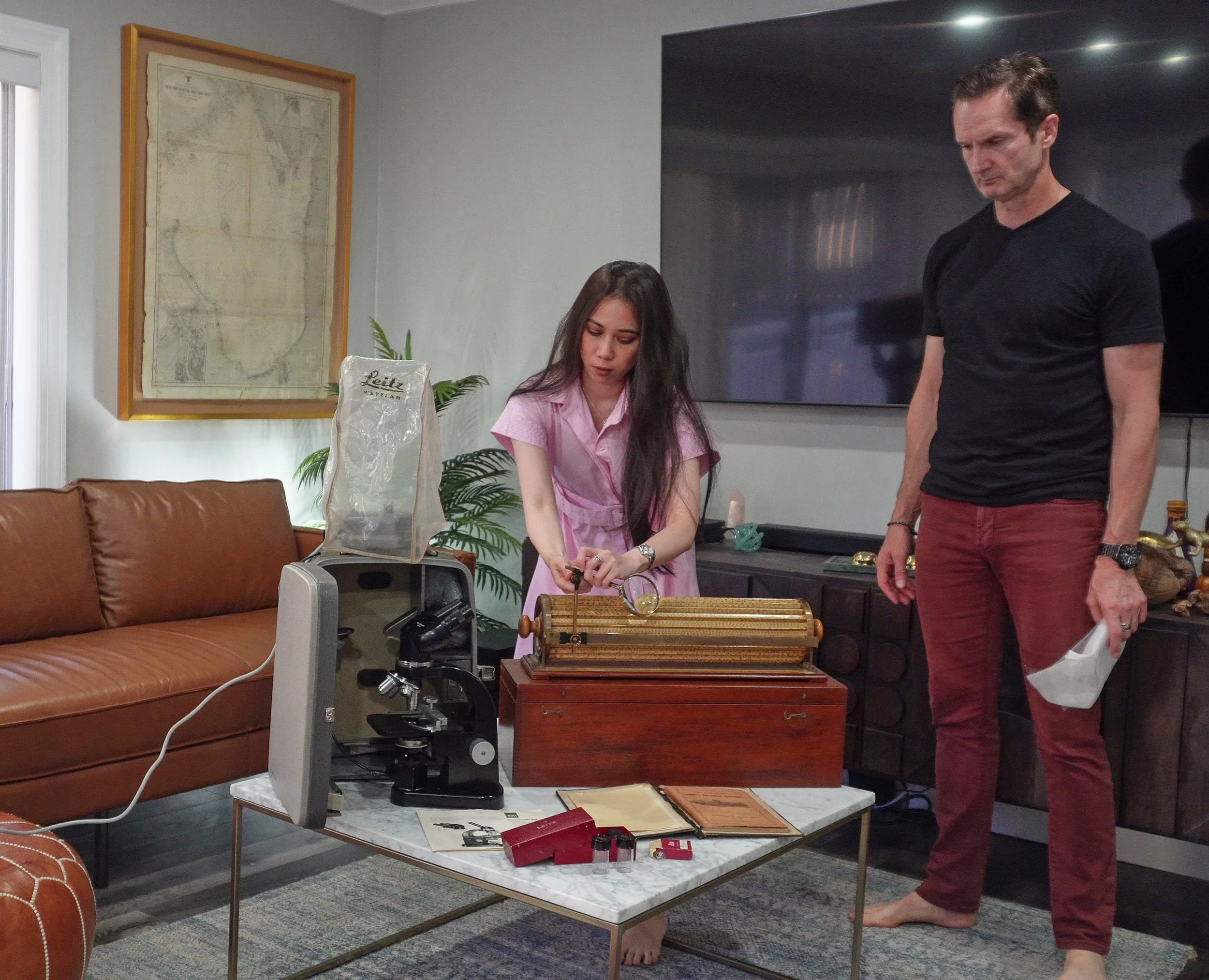
The Founder, Curator & Archivist
Angelica-Lorraine Calado Lee-Wagenknecht (A-L.C.L. Wagenknecht) is a physicist, writer, filmmaker, systems architect, and cultural founder whose work moves between science, philosophy, aesthetics, ethics, correspondence, design, and historical preservation.
Born in the Philippines in 1992, Wagenknecht was shaped by an early immersion in classical philosophy, music, ballet, theatre, the history of navigation, material culture, and German monastic academic traditions. Her childhood environment was filled with antique maps, grandfather clocks, maritime imagery, and objects whose histories extended far beyond their immediate use.
From an early age, she instinctively read such objects not simply as things, but as evidence of the people who made them, used them, valued them, and left them behind.
After immigrating to the United States at eighteen, she earned a Bachelor of Arts in Physics with a concentration in Astronomy from San José State University.
Her early technical and public-service work included United States Department of Defense projects involving lightning-strike prediction modelling for NASA Kennedy Space Center through the Air Force Institute of Technology at Wright-Patterson Air Force Base; service as an officer in Civil Air Patrol, the auxiliary of the U.S. Air Force; advocacy involving neurodivergent individuals and law enforcement; and a federal civil-rights case.
A long-standing fascination with human consciousness and the mechanics of the brain also led her to participate as a research subject in fMRI studies at the Stanford Center for Cognitive and Neurobiological Imaging, spending extended periods inside the scanner.
In a considerably lighter encounter with empirical science, she also appeared as an extra on the Discovery Channel’s MythBusters.
Rather than following the commercial path associated with her family’s established import enterprise in the Philippines, Wagenknecht pursued independent scientific, literary, cinematic, and institutional work.
Over time, that work developed into a network of ventures and cultural projects concerned with interdisciplinary thought, historical precision, design, communication, material culture, and the relationship between technical systems and human experience.
At the centre of it all is a single question: how do we preserve the human soul?
Among them are:
Ab Aeterno™, an eighteenth- and twenty-first-century design house working across poetry, music, correspondence, objects, exhibitions, and moving image.
Wagenknecht Press™, the publishing and retail arm through which books, objects, cards, field equipment, and Ab Aeterno™ works are brought to the public.
Signal & Post™, a recording artist and creative project whose music developed directly from the poetry of Ab Aeterno™.
Meridianhafen Recordings™, the recording imprint through which the music of Signal & Post™ is released.
Ange Lorraine Fine Jewelry, founded after a jeweler, entrusted with the care of a rare benitoite stone mined by her fiancé for her engagement and wedding ring, disappeared.
Galerie Angelique, a former gallery for overlooked Filipino artists, established with settlement funds from her federal civil-rights case, Lee v. Intercruises, and later extended through Wagenknecht Auctions.
Wagenknecht Society for Marine Conservation, Inc., established after the rescue of hermit crabs.
BrainNForce, a now-defunct neurodivergent-centred platform developed from Wagenknecht’s experiences within academia.
At the centre of her present creative work is Ab Aeterno™, whose first body of poetry arrived over the course of days and was subsequently translated into physical form through limited-edition German Etching® broadsides, correspondence pieces, music, scent, portraiture, mechanical objects, exhibitions, and moving image.
From that poetry emerged the music of Signal & Post™, released through Meridianhafen Recordings™, followed by an expanding body of work that includes scented candles paired with corresponding soundscapes, bespoke portrait miniatures, mechanical music boxes, exhibitions, wedding-music licensing, and forthcoming work for film and television.
Together, these projects developed into a House of Poetry, Music, Objects & Design Across Two Centuries.
The same instinct—to preserve systems of thought by preserving the material through which they were expressed—also shaped Wagenknecht’s long-term assembly of rare books, manuscripts, maps, scientific and mathematical instruments, works on paper, writing materials, legal documents, devotional objects, and historical artefacts.
That broader collecting practice was later given institutional form through The Major André Collection™, an independent not-for-profit museum, research archive, and educational institution.
The Collection brings together material spanning multiple centuries in order to examine the intellectual, military, artistic, scientific, religious, and material cultures surrounding the eighteenth century and their continuation into later generations.
Its work is grounded in primary-source study, provenance research, preservation, digitisation, education, institutional collaboration, and the careful reconstruction of historical context from dispersed material evidence.
The Collection’s institutional development is supported by its Vice President, U. Wolfgang Wagenknecht, a former German naval mine-clearance diver, director, and screenwriter.
Approaching historical preservation as both a scholarly undertaking and an act of custodial repair, Wagenknecht works from the premise that objects become more meaningful when they are returned to relationship with the systems, people, and ideas that produced them.
Her work as founder, curator, and archivist is guided by a simple principle:
history becomes more precise when its surviving fragments are returned to conversation with one another.
Additional & Forthcoming Work
In addition to the work above, Wagenknecht is developing projects for the screen under 1780 ↔ 2026.
The first instalment, Forever Is Also Now, is a nonfiction screen project tracing the origins of Ab Aeterno and the personal and creative history from which its first body of work emerged.
In 2026, Wagenknecht also produced a five-minute short film, marking her return to screen work behind the camera.

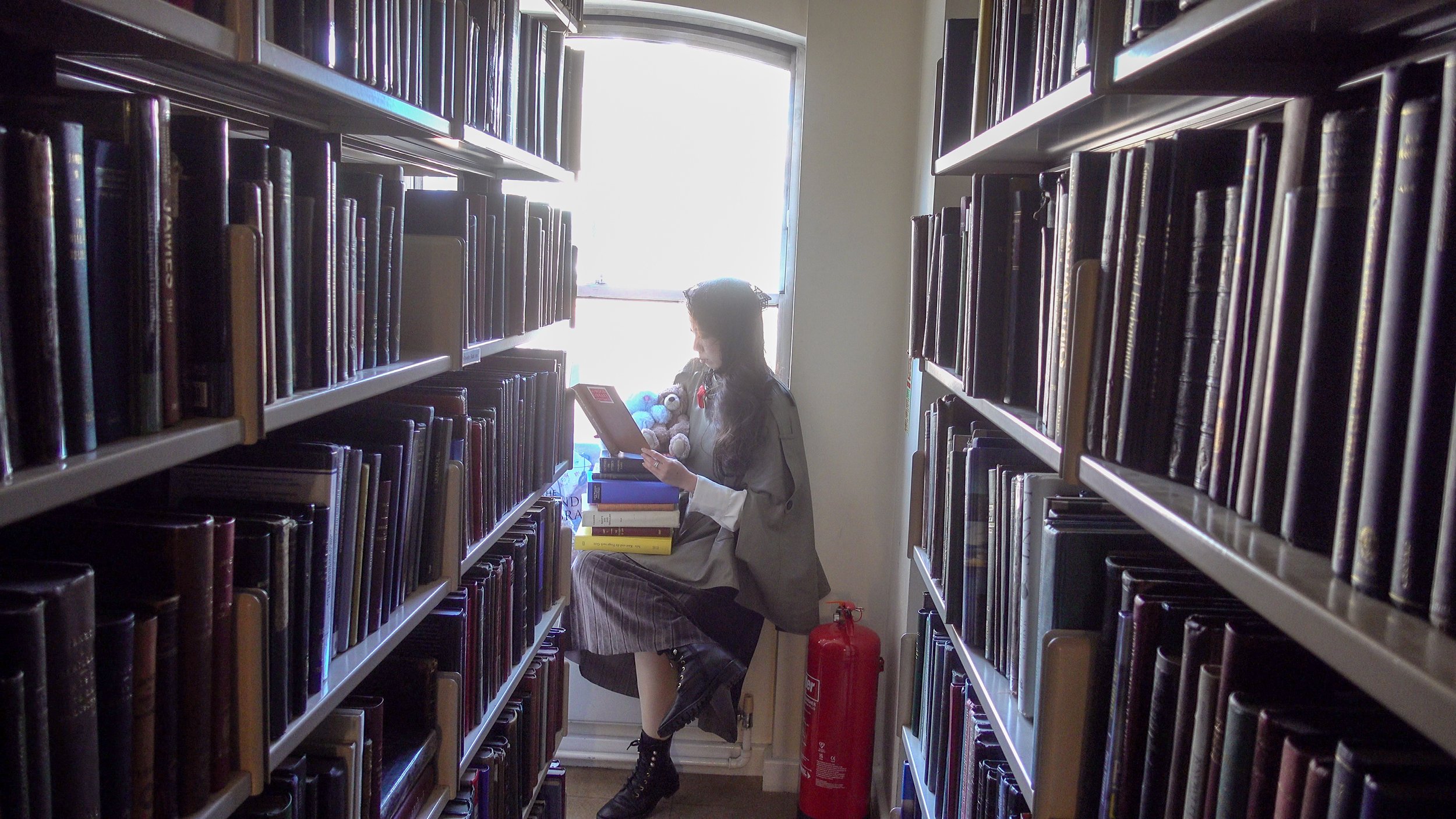
Angelica-Lorraine Wagenknecht; Founder, Curator & Archivist of The Major André Collection™.
Press & Television →